fence lines
Go to the home page How to contact One Step Integrated Pest Management
disease control bed management grub control fence line maintenance dollar spot lawn disease snow mold lawn disease
gravel parking lots
parking lots
grub control

General Lawn Care Tips

Proper Mowing

Landscape Watering

Thatch

Crabgrass

Watering

Growing Grass In Shade

Soil Testing

Proper Mowing

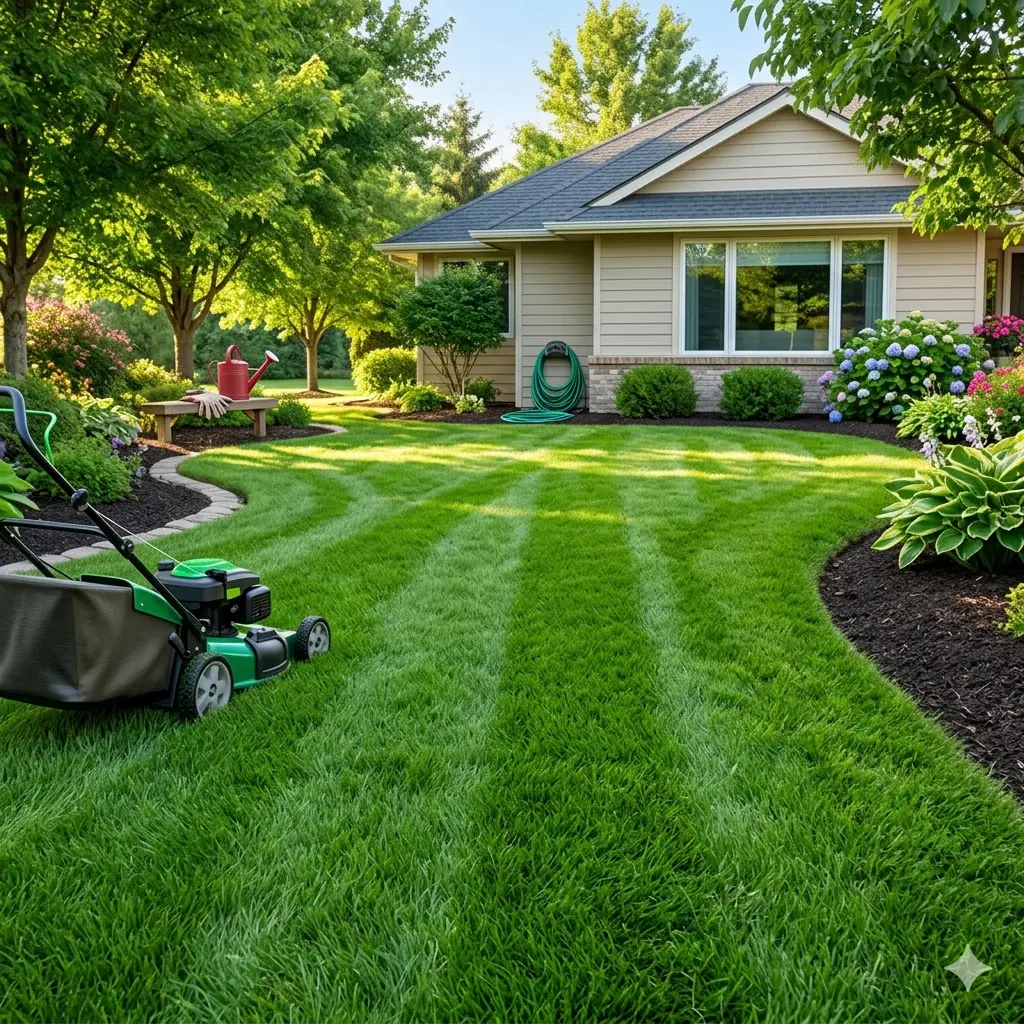
Many people who want a handsome lawn do not realize just how important the job of mowing really is. There are five dimensions of mowing to be considered. (a) Cutting height (b) Mowing Frequency (c) Mowing pattern (d) Blade Sharpness, and (e) Disposal of clippings.

Height

Cutting height of different varieties of grass is mentioned below. Lowering the cutting height can be disastrous. Removal of a large portion of the leaf results in reduced carbohydrate production, because the leaves are largely responsible for photosynthesis.

Frequency

The general rule for mowing is that no more than 1/3 of the leaf should be removed with any one cutting. Mowing frequency varies according to the time of year, weather conditions, and general rate of growth.

Pattern

The mowing pattern is far less critical but should be considered. A side-by-side mowing pattern is acceptable if the 360° turns can be made on sidewalks or roadways. If the turf is thinning due to about face sums, try a circular cut.

Blade Sharpness

Sharp mower blades cut the grass blade cleanly. If the blades aren't they don't cut cleanly they will shred your grass. Shredding the grass blade makes the grass more susceptible to disease.

Do not remove clippings.

Short clippings decay quite rapidly and do not contribute to thatch formation. The only two situations when clippings should be removed (a) When excessive clippings may smother the lawn. (b) When surface clippings give the lawn an objectionable appearance.

The two most common errors of mowing are:

Lawn isn't mowed often enough.
Lawn is mowed too short.

The proper heights are:

Bluegrass (Common Kentucky) — 2" to 2 1/2"
Bluegrass (Improved Varieties) — 1 1/2" to 2"
Fescues — 2" to 3"
Ryegrass — 2" to 3"

© Perfco

If you need more help or information with this topic or any other lawn or tree care questions, please contact us.

:: back to top

Landscape Watering

One of the best ways to reduce the risk of potential insect or disease problems is to water the landscape properly. Nothing is more important to a plants ability to survive than proper watering. Too little water will reduce the plants ability to establish itself and thrive thereby leaving it susceptible to possible pest damage. Soils kept too moist will weaken a plant thereby leaving it susceptible to rot and other diseases. When asked to try and diagnose a particular insect or disease problem, more often than not it will somehow be related to moisture.

Factors that influence how often you may need to water are temperature, soil types, amounts of sunlight and mulch (types and amounts). The easiest way to check if supplemental watering is necessary is to check the soil. If the soil is dry to a depth of approximately ½", watering will be necessary. Some plants in the landscape could also be used as indicator plants. These are plants that typically will wilt or begin to scorch when sufficient water is lacking. When daytime high temperatures are in the mid-70s, watering once a week may be sufficient, whereas when the daytime high temperatures are in the mid-90s, watering as often as every other day may needed. Clay soils will typically hold more moisture than sandy soils so adjustments may be needed based on the soil types. Heat stressed areas of the landscape may also need more attention than the shaded areas. Stone mulches may also require more water than a wood type mulch since moisture will evaporate faster from the stone mulch.

As for the amount of water, the soil should be kept moist but not water logged. Watering once a week thoroughly is better than a quick brief showering every other day. Watering the area underneath the plant is best. Simply let a slow gentle stream of water run from the garden hose in this area. An occasional watering over the tops of the plants will also be beneficial in washing the plants free of potential insect problems. Yes, washing is beneficial in pest management.

The best time to water is in the morning. This gives the plants time to dry off thus reducing the possibility of disease problems. Midday watering is O.K. but realize that more water may be needed to offset the evaporation that occurs. Also, plants may scorch in the mid day sun if water is left on the plant surface. Evening would be the worst time to water. It lets the water sit overnight on the plant surface and increases the potential of disease activity. Watering at the least preferred time is still better than not watering at all.

Watering the landscape today is much easier than in the past. Complete irrigation systems can be installed using the latest equipment. Various types of irrigation heads, hoses, connectors and nozzles can be purchased at the local Home and Garden center.

If you need more help or information with this topic or any other lawn or tree care questions, please contact us.

:: back to top

Thatch

Thatch is the layer of living and dead stems, roots, and crowns that forms a type of blanket over the soil of your lawn. A small amount of thatch (one-half inch or less) is acceptable and even good for the lawn. But when thatch accumulates to over one-half inch, it can become one of a lawn's most serious enemies.

Keeps out the good and protects the bad

Like an old-time thatched roof, the thatch on your lawn creates a barrier which prevents the free movement of water, air, fertilizer, and insect controls into the soil. Since thatch is an ideal breeding ground for many diseases and turf-destroying insects, a heavy thatch layer can quickly become a serious problem.

Grass clippings not to blame

Contrary to popular belief, grass clippings are not the prime cause of thatch build-up. Clippings are almost all water. Once dried, clippings add very little bulk to the thatch layer. Thatch is mainly made up of the heavier crowns, stems and roots. Clippings of moderate length can be left on the lawn without fear of quickly increasing the thatch layer.

Reduces lawn care effectiveness

Heavy thatch prevents fertilizer and water from reaching the grass roots. This can result in a lawn that is thin, off-color, and prone to disease, insect, and drought problems.

You have two choices.

You can ignore the thatch, and hope it will decay before it does any harm. However, a thatch problem will almost always get worse with time, not better.

The second alternative, the option we most often recommend, is core aeration because it offers the least amount of disturbance to the healthy plants.

If you need more help or information with this topic or any other lawn or tree care questions, please contact us.

:: back to top

Crabgrass

Crabgrass is an annual weed. This means it dies completely every year and sprouts new from seed produced the year before. A healthy crabgrass plant produces up to 4,000 seeds during its short one-season life.

Why it's such a problem

Crabgrass is a very fast-growing plant. It has to be because it only has one season to live. Since it grows so fast, it can choke out slower-growing permanent grasses in your lawn. Once crabgrass gets a foothold, a cycle of summer crabgrass followed by winter weeds begins, leaving patches of bare dirt in the seasons in between.

Stopping the invasion

To get crabgrass under control, a thick stand of desirable grass has to be established. To do this in one season, the best approach is to concentrate on eliminating the crabgrass through the spring and summer. Use of pre-emergents (to stop the seed from sprouting) or post-emergents (to eliminate the plants once they germinate), or a combination of both is the best way to do this. Plan your seeding for late summer or early fall, and try to establish the new grass soon enough to mow it two to five times during the fall. Then an application of pre-emergent the following spring will be effective against any crabgrass, without harming your new turf.

© 1991 Focal Point Communications

If you need more help or information with this topic or any other lawn or tree care questions, please contact us.

:: back to top

Watering

Common errors.

The most common error committed by people is light irrigation. Too little water too often encourages a multitude of problems such as shallow root system. The need for watering depends mainly on your soil and of course, the weather.

Rainfall is no guarantee.

Light showers merely wet the surface. Short down pours do the same. Most of the water is lost in runoff before it can soak in.

How much water is needed?

A lawn will use as much as two inches per week in hot, dry weather — a fraction of that when it is cooler. If you decide your lawn needs water, you should put on enough to wet the entire root zone.

When is the best time?

If you can, avoid late afternoon or evening irrigation. Grass that stays wet for a long time favors development of diseases. However, do not avoid watering at these times if this is the only time you can water. The important thing is water. Avoiding late afternoons is secondary to providing the needed water. In heavy clay soils prevent watering to the full amount at one time, frequent watering is then necessary.

© Perfco

If you need more help or information with this topic or any other lawn or tree care questions, please contact us.

:: back to top

Growing Grass In Shade

Grass plants have four basic needs

In order to survive they need light, air, water, and nurtrients. In other words, you need sufficient amounts of L.A.W.N. in order to have a full, healthy lawn. Even if one of these basic needs is not met, the grass may begin to decline and eventually die.

The problem we come across, in many older landscapes, is heavy shade caused by large trees. Trying to maintain turf in these areas is very difficult and often times impossible due to the lack of one or all the ingredients in L.A.W.N.

Light

The lack of light is the most obvious problem that shade creates. Turf requires 3-4 hours per day to remain thick and healthy. Lawns receiving less than this tend to be thin and weak.

Air

Although air is available in shade areas, location of trees or the amount of trees in the yard can create a problem with sufficient air movement or circulation. This can cause excess dampness, which can lead to disease or fungus activity.

Water

Between 1-2” of water each week throughout the growing season is required for a healthy lawn. The lack of rain is a problem because the tree will act as an umbrella and not allow rain to get to the ground. Because of this, the soil under the tree does not receive adequate moisture or valuable nutrients that rain provides.

Nutrients

The nutrients that do reach the turf, either by rain or fertilization, are being taken up by the roots of the tree as well as the turf roots. A complete soil test will show the nutritional make up of your soil and will determine the type of fertilizer required for your situation. (See our seasonal tip about soil testing.)

Here are a few tips on how to possibly improve the situation:

Do you need the tree?

Often times, too many trees were planted because people did not realize how big they would be when full grown.

Thin the tree

You can thin the tree by removing some inner branches or raise the canopy by removing some lower branches.

Add some topsoil

Tree roots are near and often on the surface not allowing enough soil for turf plants to grow. They’re also robbing the plants of valuable nutrients.

Reseed

Only after doing some or all of these other things, loosen the soil with a rake and reseed. Some varieties of grass do better than others, so be sure to read the labels and stay away from annual varieties.

Reminder

Whenever you do any seeding, be sure to keep soil damp by watering daily for about 3-4 weeks. You may have to water more often each day depending on the type of soil you have. You can cut back to weekly watering once you establish good turf growth.

If you need more help or information with this topic or any other lawn or tree care questions, please contact us.

:: back to top

Soil Testing

Whether you are trying to establish a lawn or simply maintain an existing one, you need to first know what condition the soil is in. The success or failure of any crop, from corn to turf grass, can be linked directly to the health of the soil in which it is growing. Without the proper nutrient levels in the soil, plants will be unable to thrive and remain healthy.

A complete soil test should be done in order to determine your soils pH and nutrient levels. This is done by pulling several soil cores from throughout the lawn area. Remove the cores at a depth of about 1-2 inches, then remove any thatch from them and put them in a bag or other suitable container for shipment. Once the sample is collected, send it to a qualified laboratory for testing.

Your local extension agent can usually provide you with a listing of qualified labs for this type of work. Once you receive your test results, you can then determine your fertilization requirements as well as any additional soil amendment requirements, such as lime, that may be needed.

Most fertilizers for home lawns contain 3 major nutrients, nitrogen, phosphorus, and potassium, all of which are necessary for good plant health. Each of these nutrients are responsible for different portions of the plants development. If your soil is lacking in one or more of these nutrients , you may see a decline in the health or vigor of your turf.

At One Step, we believe so strongly in the importance of soil testing, we have made this the foundation of our exclusive "Natural Care Plus" lawn care program. We begin each of our full service customers with a complete soil test for their lawn. Once we know the pH and nutrient levels of each individual lawn, we can then tailor our program to deliver exactly what is required for optimum turf growth and development.

If you need more help or information with this topic or any other lawn or tree care questions, please contact us.

:: back to top


soil management


Oxygen

A turf area just 50-feet by 50-feet absorbs carbon dioxide, ozone, hydrogen fluoride and perosyacetyle nitrate and releases enough oxygen to meet the needs of a family of four. The grass and trees along the U.S. Interstate highway system release enough oxygen to support 22 million people.

Front Lawns
Turfgrass
Playing Fields


aeration
soil analysis
wester new york lawn care tree care shrub care

Home | Contact Us | About Us | Services | What Others Say | Ask the Experts | Seasonal Tips | FAQs | Make a Referral | Commercial Accounts
©2004 One Step Tree and Lawncare. All Rights Reserved.